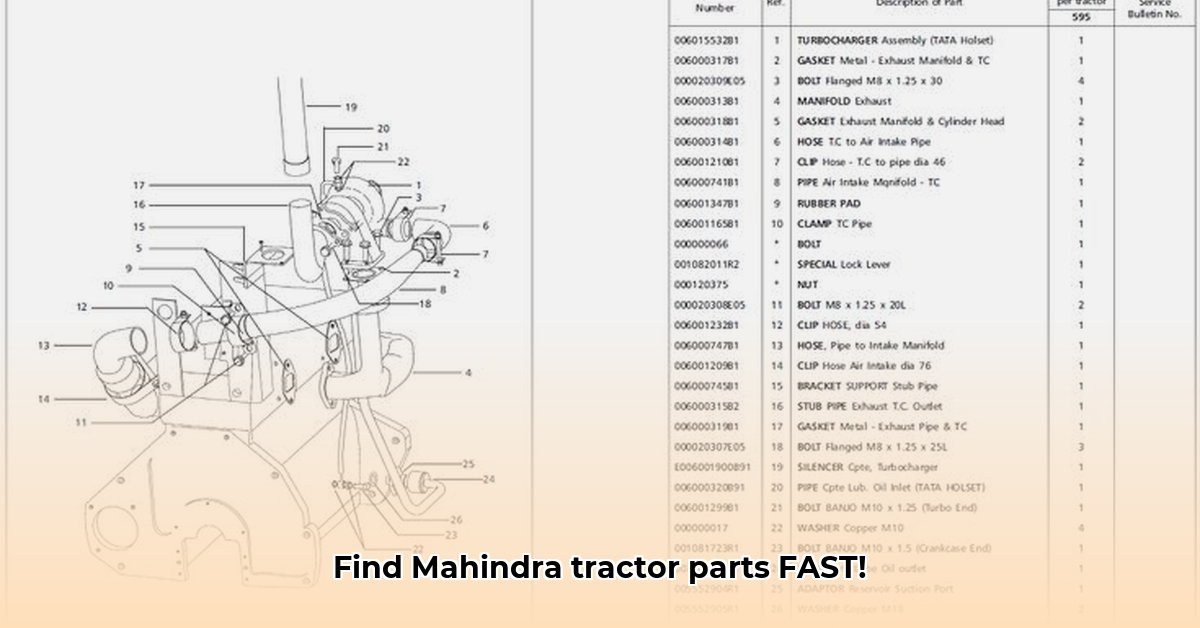
Getting your Mahindra tractor back up and running quickly is crucial, and finding the right parts efficiently is the first step. This article provides a comprehensive guide to locating and utilizing the Mahindra tractor parts catalogue PDF, along with an analysis of Mahindra's parts supply chain. We'll explore areas where Mahindra excels and identify areas needing improvement. For additional helpful resources, check out this useful chart.
Mahindra's Parts Supply Chain: A Critical Review
Mahindra has undertaken initiatives to improve its parts supply chain, focusing on faster delivery and enhanced online resources. However, a lack of publicly available data regarding key metrics like market share and customer satisfaction rates makes a comprehensive assessment difficult. While anecdotal evidence suggests improvements in some areas, quantifiable data is needed to objectively measure the effectiveness of these changes. This lack of transparency hinders an accurate evaluation of Mahindra's performance compared to its competitors.
The effectiveness of Mahindra's parts supply chain is heavily reliant on its dealer network. While some farmers report positive experiences regarding timely delivery and excellent customer service from their local dealers, others cite significant delays and subpar support. This inconsistency shows a need for better training, standardization of service protocols, and improved inventory management across the dealer network. A more uniform level of service is needed to optimize the entire system.
Finding and Using the Mahindra Tractor Parts Catalogue PDF: A Step-by-Step Guide
Access to the correct parts catalogue PDF is critical for efficient tractor repair. Here's a straightforward guide to locating and navigating this essential resource:
Step 1: Accessing Mahindra's Official Website: Begin by visiting the official Mahindra website. Navigate to sections such as "Owner Resources," "Parts," or "Support," typically designed for tractor owners. Using the manufacturer's official website is always the safest and most reliable option.
Step 2: Specifying Your Tractor Model: The website will likely require you to specify your tractor's exact model number. This is crucial to ensure you receive the correct parts catalogue. Incorrect information leads to wasted time and potential errors. Locate the model number on the information plate attached to your tractor.
Step 3: Alternative Search Strategies: If the PDF isn't directly available, conduct a targeted online search. Use precise keywords such as "Mahindra [Tractor Model] parts catalog PDF." However, exercise caution and prioritize official sources or reputable dealer websites to avoid downloading potentially harmful files.
Step 4: Navigating the Parts Catalogue: Once downloaded, familiarize yourself with the catalogue's organization. Most catalogues utilize diagrams and part numbers. The diagrams illustrate part locations, while part numbers are essential for ordering the correct components.
Step 5: Ordering Parts: Use the identified part numbers to order directly through Mahindra's website or contact your local dealer. Online ordering is often faster and more convenient, although contacting a local dealer might be beneficial in specific situations.
Tips for Effective Catalogue Usage
- Diagram Interpretation: Carefully examine diagrams to correctly identify part locations and relationships.
- Part Number Verification: Always double-check part numbers before ordering to prevent errors.
- Catalogue Updates: Check for updated versions of the catalogue, as parts and components can change.
Conclusion and Recommendations
Mahindra's efforts to improve its parts supply chain show promise, but there is room for significant improvement. The lack of readily available performance data makes independent analysis challenging. A stronger focus on consistent dealer service, enhanced website navigation, and the clear provision of parts catalogues are essential. By enhancing transparency and streamlining the parts acquisition process, Mahindra can significantly improve customer satisfaction and uptime for its valuable customers. Remember—prioritize safety when making repairs, and always consult your tractor's owner's manual.